
IMPORTANTGoogle has released a new statement regarding a new “advanced flow” for “power users” to install unverified apps and bypass developer verification. More information can be found at the end of this article.
The future of Android looks bleak.
Last August, everyone was blindsided by Google’s announcement of their new “Developer Verification”, with this proposed rollout timeline:
| Date | Milestone |
|---|---|
| August 2025 | Developer Verification announced |
| October 2025 | Verification early access begins |
| March 2025 | Verification begins globally |
| September 2026 | Verification enforcement begins in Brazil, Indonesia, Singapore, and Thailand |
| January 2027+ | Verification enforcement begins globally |
In Google’s own words, they describe it like this:
Think of it like an ID check at the airport, which confirms a traveler’s identity but is separate from the security screening of their bags; we will be confirming who the developer is, not reviewing the content of their app or where it came from.
This is a terrible analogy.
A better analogy for developer verification would be like a government agent that is stationed at your front door, identifying everyone who tries to enter your home (even with your permission), asking headquarters whether they should be allowed into your home, and only then letting them pass. Under this system, you cannot make the agent go away, and countless of your friends are turned away because they don’t have a government ID to prove their identity.
How “Developer Verification” really functions is that in order to distribute apps outside of the Play Store, developers will now have to send Google a ridiculous amount of personal information. This includes full name, physical address, phone number, a GOVERNMENT ID, among other things. And in exchange for essentially selling their soul, Google will “approve” one of the developer’s signing keys, and allocate a globally unique package name (that is also verified, of course) to be installed on Android devices.
This is insane invasion of privacy for privacy-minded developers that wish to remain anonymous for their own safety and not dox themselves to Google, and by extension, law enforcement.
Whenever a device will try to install an application, the package name and signature of the app will be sent off to Google, to verify that it is “approved” for installation. This means that sideloading now requires an internet connection, which by itself is already somewhat insane, but now Google will have a FULL list of ALL the applications installed on your device. This is an incredible violation of user privacy, all for essentially nothing.
While this places an immense burden to independent developers (which most often are open-source developers), malicious actors are practically unaffected. Today, it is easier than ever to obtain a leaked government ID, from the numerous hacks that have occurred as a result of enforcing draconian age checks (UK’s Online Safety Act). With this, malicious actors can easily keep distributing malware, with little to no barriers in their way.
“Developer Verification” is really about complete control over the Android ecosystem. This is a censorship tool that will be used to single out any application, and blocks its installation on any “certified” Android devices, which are, all of them outside China. Even limited control has been used to remove applications without reason, such as last year when Apple removed ICEBlock from the App Store, and Google removed similar apps from the Play Store after pressure from the Trump administration.
NOTEGoogle later clarified that “certified Android devices” referred to any device running a stock manufacturer ROM, that was Android 16 QPR2 and higher (not yet released). In reality, this will target all new Android phones from the typical manufacturers, and many older phones that will update to Android 16.
In the case of Android, apps taken off the Play Store would still be distributable through other means, such as a direct download from websites, through online forums, chats between people, and so on. Android normally allows the installation of any app the user wishes to install, much like any desktop operating system, as it should be. But with these new changes, all app installations are subject to Google’s control. This effectively turns Android into iOS’s walled garden, where sideloading practically* doesn’t exist. One of the defining features of Android since its inception has been the ability to use the device you purchased in any way you wanted. That’s been slowly going away for many years by now, but this would be the final nail in the coffin.
* It is possible to sideload apps on iOS without a jailbreak, however it is rather difficult compared to Android, and has many intentional restrictions that make it quite painful.Let’s not forget the greatest loss from this change: open-source applications. I, and many other developers, will not be handing over our personal lives over to Google just to distribute our applications. Instead, we will have to teach normal users the increasingly convoluted methods to install apps, using the same methods that are normally meant for app developers.
As a result, non-technical users would no longer be able to access mods, specialized censorship bypasses, console emulators, and many more things. But this affects everyone, even those who know about the workarounds. Many developers that do not want to deal with this nonsense will simply give up and stop maintaining their projects, leaving their codebases to rot. The greatest loss that will come from this disaster is the death of Android open-source.
What is more insane is that there appears to be little to no workarounds for this, for people who intentionally want to install applications from non-Google sources. Not that it was simple to do in the past anyways; users had to explicitly enable installing from unknown sources in their settings, facing scary warnings about security in the process. As we will later see, the only methods left are almost completely inaccessible and unknown to the average user, which leaves them completely stranded.
In a late September blog post and podcast, Google provided some more clarification about the exemptions for Developer Verification. In particular, two things stand out:
-
Android Studio is unaffected because deployments performed with
adb, which Android Studio uses behind the scenes to push builds to devices, is unaffected. -
Apps installed through enterprise management tools on managed devices will also be installable without being registered.
In regards to the first statement, the Android Device Bridge (adb) is used during development to install applications and directly
run shell commands on the device. It is utilized by Android Studio to build and push debug versions of apps to a device for testing.
This exemption is similar to what exists on iOS, with the difference being that no sign-in with your Apple ID is required as on iOS.
However, an adb connection requires either a physical USB connection, or a wireless one on the same network.
As for the second statement, Android has long had support for “enterprise management tools” (MDM), where a specific “Device Policy Controller” (DPC) app is set as the device’s administrator app. This gives the app a significant amount of control over the device, including, but not limited to:
- Directly installing applications
- Locking the device
- Wiping the device
- Setting policies
As we can see, Google has conveniently provided an escape hatch for corporations to bypass the verification flow entirely, and fucked over everyone else.
IMPORTANTGoogle has just now released a new statement regarding a new installation flow designed for “power users” that allows installing unverified apps, bypassing developer verification.
While I began writing this article prior to this new announcement, I’ve added my thoughts on it below.
One of the only positives Developer Verification brings is the reduced likelihood of scammers successfully phishing dumb users into installing fake versions of official apps, and stealing the users’ credentials.
Google seems to have designed their new “advanced flow” with this in mind, such that it provides a larger barrier to allowing unverified installations (including a time delay to stop any pressure). I understand why this is necessary, as phishing really is a huge problem nowadays, but it is still really annoying.
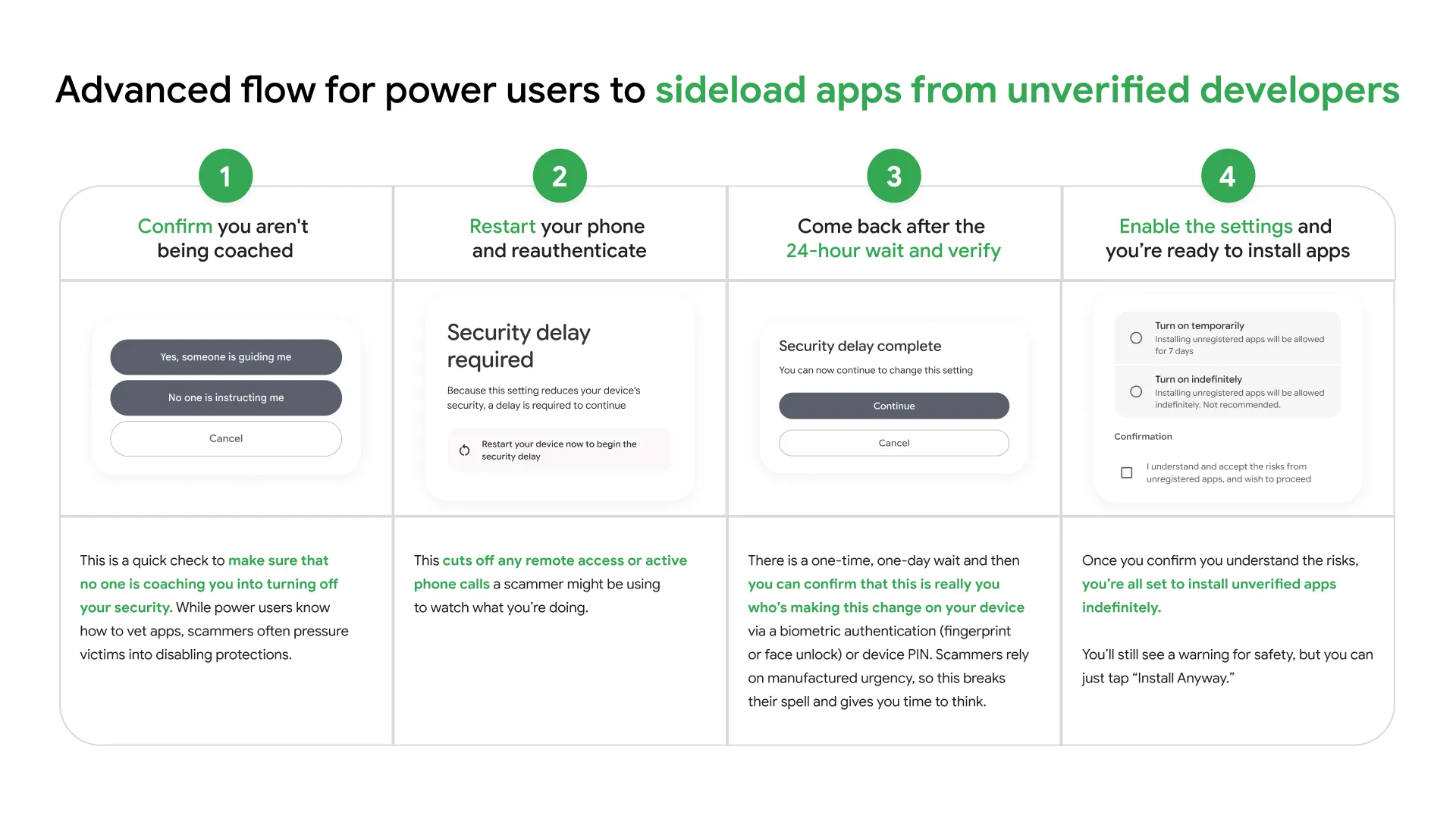
In short, un-restricting sideloading will now be more difficult (but not ridiculously so):
- Enable Developer Mode on the device
- Navigate to Developer Options > “Allow Unverified Packages” > Complete a scare prompt
- Enter device pin/password
- Restart the phone (to ensure any scam calls are dropped)
- Wait 24 hours
- Navigate again to Developer Options > “Allow Unverified Packages” > Complete another scare prompt, and then enable installing unverified apps for 7 days or permanently.
The biggest issue with this is that this policy can be retroactively changed, be made more restrictive, or even removed altogether at the whim of executives or lawyers. Since it’s implemented through the Android OS and Google Play Services, this functionality can be changed remotely and without any prior warning, effectively killing Android overnight.
However, assuming we take Google at their word (even if it’s increasingly difficult to do so), this flow does still allow for regular users to access sideloading like before, even if it’s more difficult to do so. The biggest hurdle is obviously the 24-hour waiting period, which will inevitably result in fewer first-time as it becomes too much of a hassle to follow through with the installation process.
For more up-to-date information, visit keepandroidopen.org